Going into software development blindly results in cost overruns, missed deadlines, and unhappy customers. Every reliable software product — whether a banking platform, a SaaS application, or an internal enterprise tool — follows a disciplined process behind the scenes. That process is the Software Development Life Cycle (SDLC).
SDLC is not just a theoretical framework. It is a practical system that helps organizations build software that is predictable, secure, scalable, and maintainable. When followed correctly, SDLC reduces project risk, controls cost, improves quality, and ensures alignment between business goals and technical execution.
Key Takeaways
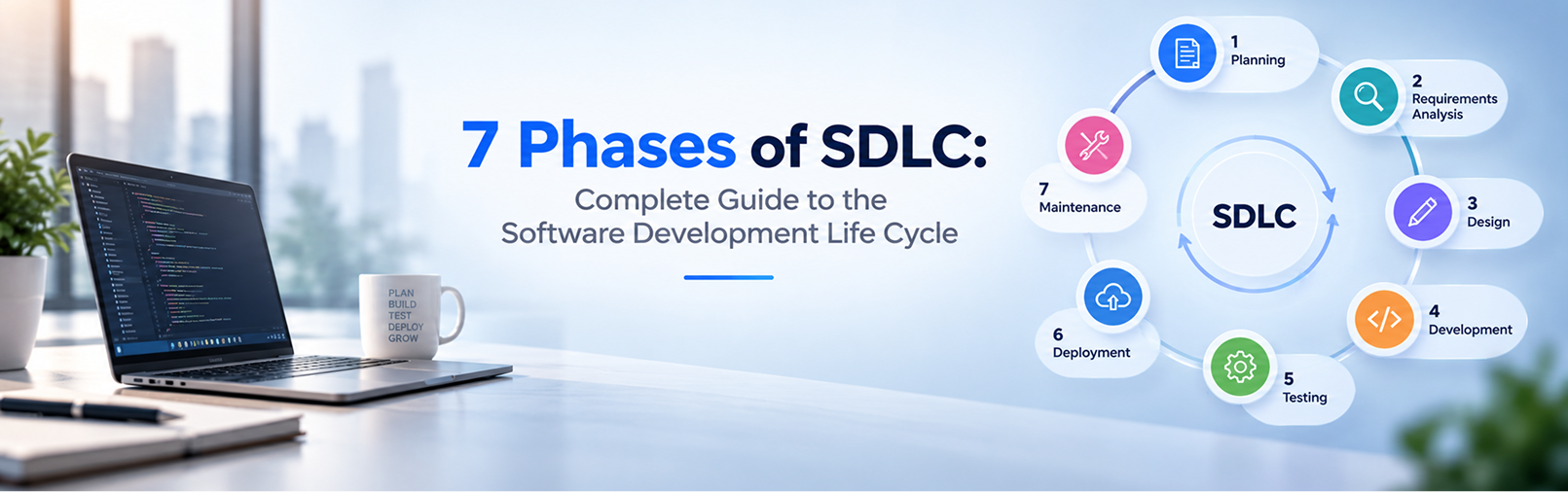
- 1SDLC (Software Development Life Cycle) has 7 phases sometimes called steps: Planning, Requirements, Design, Development, Testing, Deployment, and Maintenance.
- 2Common SDLC models (also called SDLC methodologies) include Waterfall, Agile, Iterative, Spiral, V-Model, and DevOps.
- 3Agile suits fast-moving teams; Waterfall and V-Model suit regulated, fixed-scope projects.
- 4Security should be built into every phase (DevSecOps), not added at the end.
SDLC Meaning? A Quick Overview
SDLC (Software Development Life Cycle) is the step-by-step process teams follow to plan, build, test, and maintain software from the first idea through to long-term support after launch. In simple terms, SDLC is the roadmap that turns a business requirement into working, reliable software.
Its importance lies in three areas:
- Risk reduction — Problems are identified early, when they are cheaper to fix.
- Quality assurance — Clear checkpoints ensure software meets functional, performance, and security standards.
- Business alignment — Development decisions are tied to business requirements, not assumptions.
Without SDLC, software development becomes reactive. Teams fix symptoms instead of causes. Costs rise. Timelines slip. Quality suffers. SDLC provides discipline without rigidity.
Why Is SDLC Important for Businesses?
Keeping up with software development can be difficult due to shifting priorities, new tools, and cross-department collaboration. SDLC gives every stakeholder a systematic management framework with defined deliverables at each step. Adopting SDLC allows a business to:
- Keep projects on track and within budget
- Ensure code quality at every stage
- Prevent bugs and security vulnerabilities from reaching production
- Align product capabilities with business goals
- Prioritize work and eliminate redundant effort
- Reduce costly post-release changes that damage user experience
Common SDLC Models (SDLC Methodologies)
Different organizations apply SDLC through different models — also called SDLC methodologies — based on project complexity, regulatory requirements, and how often change is expected.
Waterfall Model
01
Linear and sequential — each phase must be completed before the next begins. Best for stable, clearly defined projects in regulated industries such as finance, healthcare, and government. Limited flexibility for evolving requirements.
Agile Model
02
Iterative and incremental — development happens in short sprints with continuous stakeholder collaboration. Ideal for SaaS platforms, dynamic products, and startups where speed and user feedback are critical. See how Agile and DevOps work together to speed up delivery.
Iterative Model
03
Builds the system in repeated cycles, with each iteration adding functionality based on feedback from the last. Useful when requirements are only partly known upfront and are expected to evolve as the product takes shape.
Spiral Model
04
Combines iterative development with systematic risk analysis. Effective for large, complex, or high-risk systems where early risk mitigation is essential. More resource-intensive than Agile or Waterfall.
V-Model
05
An extension of Waterfall where every development phase has a corresponding testing phase planned in parallel. Well suited to projects with strict quality and compliance requirements, since testing is planned from day one.
DevOps Model
06
Extends Agile by integrating development and operations into a single continuous workflow. Emphasizes CI/CD automation, fast releases, and high system availability. Best for cloud-native and large-scale digital platforms — read more on the impact of DevOps on modern software development.
Which model fits your project? Choose Waterfall or V-Model when requirements are fixed and compliance matters most; choose Agile, Iterative, or DevOps when speed, flexibility, and continuous feedback matter most; choose Spiral when the project is large, complex, or carries significant risk that needs early attention.
The 7 Phases of SDLC

Planning
Planning defines why the software is being built and how success will be measured. It sets the foundation for all future decisions and determines whether the project is viable, valuable, and achievable.
Key Activities
- Business goal definition — Ensures the product solves a real problem and delivers measurable value. Keeps technical teams aligned with strategic priorities throughout the lifecycle.
- Scope identification — Defines what is included and intentionally excluded. Protects timelines, budgets, and team focus by preventing uncontrolled expansion.
- Feasibility analysis (technical, financial, operational) — Evaluates whether the project can be built using available technology, skills, and infrastructure.
- Risk assessment — Identifies potential technical, financial, security, and delivery risks early. Each risk is evaluated for likelihood and impact so mitigation strategies are in place before work begins.
For teams that need formal sign-off checkpoints at each stage, see our guide to the SDLC governance phase gate model.
Deliverables
| Deliverable | Purpose |
|---|---|
|
Project charter |
Defines objectives, stakeholders, responsibilities, timelines, and success criteria |
|
High-level roadmap |
Outlines major milestones, dependencies, and release phases |
|
Budget and timeline estimates |
Provides cost and schedule forecasts to support funding decisions |
Tools: Jira, Confluence, MS Project, product roadmapping tools | Metrics: Cost variance, schedule variance, risk exposure index
A weak planning phase leads to unstable execution, cost overruns, missed objectives, and repeated rework.

Requirements Analysis
This phase translates business needs into clear, testable, and actionable requirements. It ensures all stakeholders share a common understanding of what must be built and why.
Key Activities
- Stakeholder interviews — Direct discussions uncover expectations, constraints, and success criteria from business, technical, and operational perspectives.
- Functional and non-functional requirement gathering — Functional requirements describe system behavior. Non-functional requirements define performance, security, scalability, and compliance standards.
- Use case creation — Illustrates real-world user interactions with the system, validating requirements against practical scenarios.
- Requirement prioritization — Requirements are ranked by business value, urgency, and risk to enable phased delivery.
Stakeholder Alignment
- Business owners — Validate that requirements align with business goals and confirm strategic fit
- Technical teams — Confirm feasibility, dependencies, and implementation approach
- End users — Ensure usability and relevance to daily workflows
A Requirement Traceability Matrix (RTM) ensures each requirement is designed, developed, tested, and delivered. RTMs prevent scope creep, missed features, and unverified functionality and are essential for audits and compliance.

Design
Design translates requirements into technical blueprints. Strong design reduces complexity, improves scalability, and lowers long-term maintenance costs.
Key Design Areas
- System architecture — Defines the overall structure, components, and interactions. Poor architecture is expensive to fix later.
- Data models — Specify how data is structured, stored, accessed, and secured.
- API contracts — Define how systems and services communicate, reducing integration errors.
- UI/UX structure — Focuses on usability, accessibility, and consistency. Good UX improves adoption and reduces training effort.
Architectural Decisions
| Decision | Consideration |
|---|---|
|
Monolithic vs microservices |
Scalability, deployment flexibility, operational complexity |
|
Cloud vs on-premise |
Cost, compliance, control, and governance |
|
Scalability and performance |
Caching, load balancing, horizontal scaling |
Security Design
- Authentication and authorization models
- Data encryption standards (at rest and in transit)
- Threat modeling — identifying attack vectors before code is written
Deliverables: High-level design (HLD), low-level design (LLD), security architecture documents. Good design minimizes rework, improves stability, and reduces technical debt.

Development (Coding)
This phase converts approved designs into working software through disciplined engineering practices.
Key Practices
- Modular development — Breaks the system into manageable, reusable components that can be scaled and tested independently.
- Clean coding standards — Ensures readability, consistency, and long-term sustainability. Reduces onboarding time and simplifies debugging.
- Reusable components — Reduces duplication, improves consistency, and accelerates future development.
Code Review: Peer reviews ensure consistent quality, maintainability, and adherence to security standards. Version Control: Git-based tools enable parallel development, rollback capabilities, and controlled release management. Quality Gates: Automated checks enforce minimum code coverage, static analysis rules, and build success thresholds.

Testing
Testing validates that the software meets requirements and behaves safely under expected and unexpected conditions.
Types of Testing
- Unit testing — Validates individual components in isolation.
- Integration testing — Ensures components work together correctly.
- System testing — Verifies end-to-end functionality against requirements.
- User acceptance testing (UAT) — Confirms the system meets business expectations.
For a deeper breakdown of testing types and when to use each, see our full guide: Types of Software Testing Explained. If you’re deciding how much to automate, our manual vs. automation testing guide breaks down when each approach makes sense.
Continuous and Automated Testing
Testing is embedded throughout the pipeline. Automation improves execution speed, test coverage, and consistency across releases — enabling frequent releases while reducing manual effort.
Key Metrics
- Defect density — Measures code quality; high density indicates risk.
- Test coverage — Higher coverage reduces unknown risk and improves confidence.
- Defect leakage rate — Tracks defects escaping to production; low leakage protects user trust.

Deployment
Deployment moves software into production safely and predictably. Controlled deployment reduces downtime and failures. CI/CD Pipelines enable faster releases, reduced manual errors, and predictable outcomes — ensuring repeatability, rapid iteration, and reliability through automation.
Deployment Strategies
- Blue-green deployment — Switches between two identical environments, allowing instant rollback.
- Canary releases — Gradually exposes new releases to a small user segment to detect issues early.
- Rolling updates — Applies updates incrementally, ensuring continuous availability.
Reliability focus areas: Rollback strategies · Real-time monitoring · Performance readiness checks. Deployment success depends on preparation, not speed.

Maintenance
Maintenance ensures the software remains functional, secure, and relevant after release. It protects the original investment.
Key Activities
- Bug fixes — Resolve production issues quickly to restore stability and maintain user trust.
- Performance monitoring and optimization — Continuously tracks speed, uptime, and resource usage.
- Feature enhancements — Support evolving user and business needs, keeping the product competitive.
- Security updates and patching — Address vulnerabilities and compliance gaps to reduce risk as new threats emerge.
- End-of-life planning — Defines when and how an aging system will be retired, migrated, or replaced.
Support Metrics
- Mean Time to Resolution (MTTR) — Support efficiency and operational maturity.
- Incident frequency — System stability; frequent incidents indicate deeper issues.
- Customer-reported issues — Real user experience and service quality.
Regular lifecycle updates keep the system secure, compliant, and aligned with business goals.
Integrating Security at Every Phase (Secure SDLC / DevSecOps)
Security cannot be an afterthought. A DevSecOps approach integrates security into every phase of the SDLC, reducing breaches, shortening response times, and strengthening system resilience. Security delayed is security denied.
| SDLC Phase | Security Practice (DevSecOps) |
|---|---|
|
Design |
Threat modeling — identify attack vectors before code is written |
|
Development |
Secure coding standards — prevent injection attacks, insecure auth, data leakage |
|
Testing |
Vulnerability scanning — detect misconfigurations and outdated dependencies |
|
Deployment |
Access control validation — enforce least-privilege access before go-live |
This approach reduces breaches, shortens response times, and strengthens system resilience. Security delayed is security denied. For a full framework, see our guide to Secure SDLC for enterprises.
Common SDLC Mistakes and How to Avoid Them
Even teams familiar with SDLC fall into predictable traps. These four mistakes are the most costly:
Skipping requirement validation
Teams build features that miss business intent or user expectations. Fix: use stakeholder sign-offs and RTMs to confirm alignment at every stage.
Treating security as a final step
Addressing security only at the end increases critical vulnerabilities and costly rework. Fix: integrate security from design through deployment — security delayed is security denied.
Over-documentation
Excessive documentation slows progress and shifts focus away from delivery. Fix: document only what adds clarity, accountability, and control.
Ignoring maintenance planning
Failing to plan for maintenance leads to delayed fixes and security gaps post-release. Fix: allocate resources for monitoring, updates, and optimization from the start.
Real-World SDLC Case Study
A mid-sized fintech company adopted an Agile-DevOps SDLC model (client details anonymized, 2026).
2026 Case Study — Fintech SDLC Transformation
- Frequent production failures
- Long release cycles
- High defect rates
- Release frequency improved by 40%
- Production defects reduced by 60%
- Deployment failures dropped significantly
The key change was not tooling — it was process consistency across all 7 SDLC phases.
How Betatest Solutions Supports Your SDLC
Navigating the Software Development Life Cycle is complex. Betatest Solutions acts as a reliable partner at every stage:
- Planning — Helping define goals, scope, and feasibility with expert input from day one
- Requirements — Eliciting precise requirements from both technical and non-technical stakeholders
- Design — Applying deep expertise in software architecture, UI/UX, and quality assurance
- Testing — Delivering functional, performance, security, and regression testing across all environments
- Deployment — Ensuring releases go live with minimal disruption through rigorous quality controls
- Maintenance — Providing round-the-clock post-release support, monitoring, and optimization
If you’re planning a build from the ground up, explore our web development services to see how we support each SDLC phase in practice.
When you work with Betatest Solutions, you are not just building software — you are guaranteeing its long-term success.
Conclusion
The Software Development Life Cycle is not a theoretical construct but a practical framework that brings structure, accountability, and clarity to software development. By dividing the process into clearly defined phases — from planning and requirements analysis to deployment and maintenance — SDLC ensures that software is built with purpose, quality, and long-term sustainability in mind.
When combined with Agile execution, DevOps automation, and integrated security, SDLC helps organizations reduce risk, control costs, and deliver reliable systems at scale.
Teams that follow SDLC do not just build software faster. They build software that works, evolves, and continues to create value over time.
Frequently Asked Questions
What are the 7 phases of SDLC?
The 7 phases are Planning, Requirements Analysis, Design, Development, Testing, Deployment, and Maintenance — each building on the outputs of the one before it.
What does SDLC mean?
SDLC stands for Software Development Life Cycle, the structured process of planning, building, testing, deploying, and maintaining software from start to finish.
What's the difference between SDLC phases and SDLC models?
Phases are the individual steps every project moves through (like planning or testing), while a model (Waterfall, Agile, Spiral, etc.) is the overall approach for how those phases are organized and executed.
Which SDLC model is best for small teams?
Agile is generally the best fit for small teams, since it allows fast iteration and continuous feedback without the overhead that larger models like Spiral or Waterfall require.
Ready to implement SDLC in your project?
Get expert guidance on the SDLC model that fits your project — no one-size-fits-all approach.