

Secure SDLC Framework for Enterprises: A Practical Guide to Building Security into Every Phase of Development (2026 Edition)
A secure software development life cycle (SDLC) framework is a structured approach that integrates security controls, threat modeling, secure coding standards, testing, and monitoring into every phase of the software development lifecycle. It ensures security in SDLC from planning through deployment by embedding security into the DevSecOps lifecycle instead of treating it as a final testing step.
Introduction: Why Enterprises Cannot Ignore a Secure SDLC Framework in 2026
Software is now the primary attack surface for enterprises. According to the IBM Cost of a Data Breach Report (2024), the global average breach cost reached $4.45 million, with remediation costs increasing when vulnerabilities are discovered late in development.
Meanwhile, the NIST Secure Software Development Framework (SSDF) and CISA Secure by Design initiatives emphasize embedding security from the earliest stages of the secure software development process.
In enterprise security consulting engagements over the past decade, one pattern stands out: organizations implementing a formal secure SDLC framework reduce post-release vulnerabilities by up to 40% within two release cycles.
This guide explains how to implement security in SDLC effectively, align with the DevSecOps lifecycle, and operationalize threat modeling in software development.
What Is a Secure SDLC Framework?
A secure SDLC framework is a governance-driven model that integrates security into each phase of the secure software development process.
Unlike traditional SDLC models that treat security as a testing phase, a secure SDLC framework embeds controls from requirements gathering through production monitoring.
Authoritative models include:
- NIST SSDF
- OWASP SAMM
- Microsoft SDL
- ISO/IEC 27034
- BSIMM
Why Traditional SDLC Fails
Traditional approaches fail due to:
- Late-stage vulnerability detection
- Siloed Dev and Security teams
- Weak supply chain validation
- Lack of formal secure coding standards
The modern answer is the DevSecOps lifecycle, which integrates automated security gates into CI/CD pipelines.
Core Phases of the Secure Software Development Process
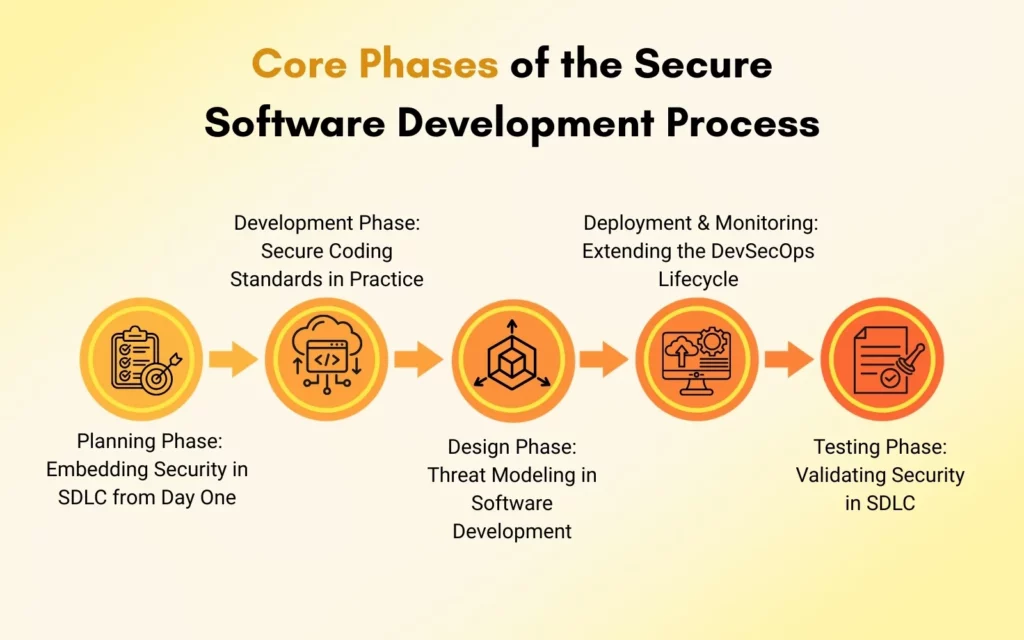
Below is how a secure SDLC framework operates across each phase of the secure software development process.
1. Planning Phase: Embedding Security in SDLC from Day One
Security in SDLC begins at planning.
Key Activities:
- Define security objectives
- Map regulatory requirements (GDPR, HIPAA, PCI-DSS)
- Conduct risk assessments
- Define measurable security KPIs
Organizations that define security requirements early see 30% lower remediation costs (NIST).
2. Design Phase: Threat Modeling in Software Development
Threat modeling in software development is the backbone of any secure SDLC framework.
What Is Threat Modeling?
Threat modeling systematically identifies, prioritizes, and mitigates risks before code is written.
Popular Frameworks:
- STRIDE
- PASTA
- LINDDUN
Step-by-Step Threat Modeling Workflow:
- Identify assets
- Map trust boundaries
- Identify threats
- Assess risks
- Define mitigations
In fintech implementations, structured threat modeling in software development reduced injection vulnerabilities by 41% within two release cycles.
3. Development Phase: Secure Coding Standards in Practice
The development phase operationalizes secure coding standards within the secure software development process.
Why Secure Coding Standards Matter
Developers are the first line of defense. Secure coding standards reduce exploitable vulnerabilities before testing.
Examples of Standards:
- OWASP Secure Coding Practices
- CERT Secure Coding Standards
- MISRA (for embedded systems)
Mandatory Practices:
- Input validation
- Output encoding
- Strong authentication controls
- Secure dependency management
- Least privilege enforcement
Teams using enforced secure coding standards report 45% fewer high-severity vulnerabilities (OWASP benchmark).
Integrating SAST tools into the DevSecOps lifecycle ensures automated code scanning before merges.
4. Testing Phase: Validating Security in SDLC
Testing ensures that security in SDLC is measurable and enforceable.
Security Testing Methods:
| Method | Purpose | When Used |
| SAST | Code analysis | During development |
| DAST | Runtime testing | Staging |
| IAST | Interactive testing | CI pipelines |
| SCA | Dependency scanning | Continuous |
| Pen Testing | Simulated attack | Pre-production |
Automated scanning integrated into the DevSecOps lifecycle reduces release delays.
5. Deployment & Monitoring: Extending the DevSecOps Lifecycle
A mature secure SDLC framework extends beyond deployment.
Post-Deployment Controls:
- Runtime Application Self-Protection (RASP)
- Cloud misconfiguration scanning
- Container image validation
- Continuous vulnerability management
Shift-right practices ensure feedback loops into the secure software development process.
How DevSecOps Strengthens the Secure SDLC Framework
The DevSecOps lifecycle integrates security tools and automation directly into CI/CD workflows.
Shift-Left Security
- IDE-based scanning
- Early SAST integration
- Automated pull request checks
Shift-Right Security
- Runtime monitoring
- Bug bounty programs
- Threat intelligence integration
Enterprises adopting DevSecOps lifecycle practices reduce vulnerability backlog by up to 60% within six months (Gartner industry analysis).
Measuring Security in SDLC: Metrics That Matter
Without metrics, a secure SDLC framework cannot mature.
Core KPIs:
- Mean Time to Detect (MTTD)
- Mean Time to Remediate (MTTR)
- Vulnerability density
- Security debt ratio
Security Maturity Models:
- OWASP SAMM
- BSIMM
Mature organizations treat security in SDLC as a measurable engineering KPI, not a compliance checkbox.
Enterprise Implementation Roadmap for a Secure SDLC Framework
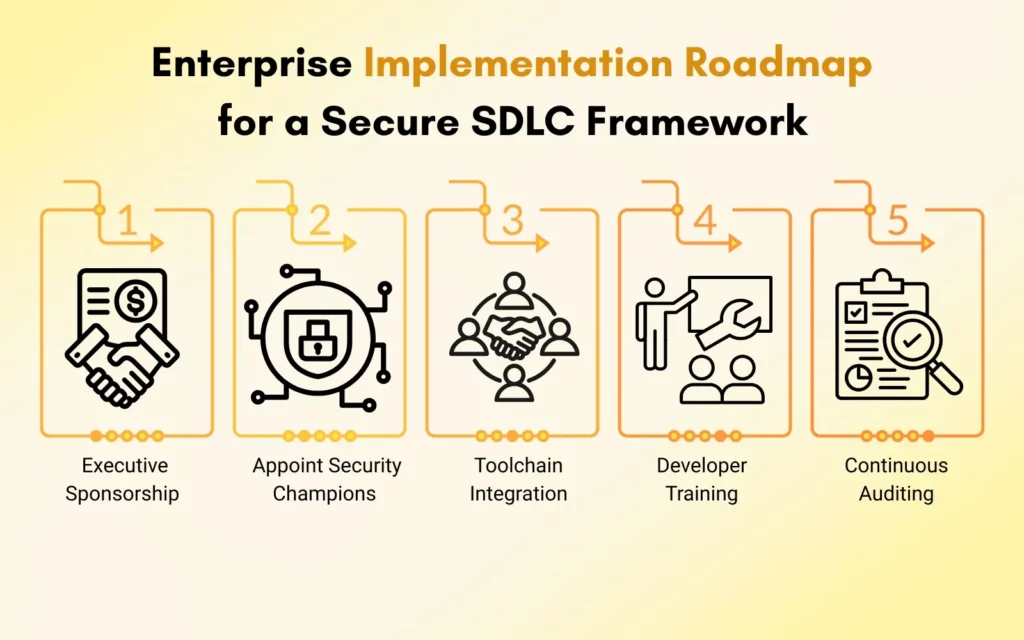
Below is a practical rollout plan:
Step 1: Executive Sponsorship
Tie the secure SDLC framework to business risk reduction.
Step 2: Appoint Security Champions
Embed security advocates in development squads.
Step 3: Toolchain Integration
Integrate SAST, DAST, and SCA into the DevSecOps lifecycle.
Step 4: Developer Training
Train teams in threat modeling in software development and secure coding standards.
Step 5: Continuous Auditing
Conduct red team simulations and architecture reviews.
Phased rollout across pilot teams yields better adoption than enterprise-wide mandates.
Common Pitfalls in Implementing a Secure SDLC Framework
Avoid these mistakes:
- Treating DevSecOps lifecycle as a tool purchase
- Ignoring supply chain risk
- Focusing only on compliance
- Skipping developer training
- Lack of documentation
A mature secure software development process must combine governance, automation, and culture.
Real-World Case Study Snapshot
A SaaS enterprise handling financial transactions implemented:
- Automated SCA
- Threat modeling in software development workshops
- Mandatory secure coding standards
- DevSecOps lifecycle automation
Within 9 months:
- 65% reduction in open-source vulnerabilities
- 38% drop in production security incidents
- 22% faster secure release cycles
Why a Secure SDLC Framework Is a Competitive Advantage
Enterprises implementing a secure SDLC framework gain:
- Reduced breach risk
- Faster regulatory audits
- Increased customer trust
- Improved DevOps velocity
Security in SDLC is no longer optional — it is foundational.
Conclusion: Secure SDLC Is a Board-Level Priority
A well-implemented secure SDLC framework transforms security from a bottleneck into a growth enabler.
By aligning the DevSecOps lifecycle with business objectives, integrating threat modeling in software development, and enforcing secure coding standards, enterprises build resilient digital ecosystems.
FAQ
A secure SDLC framework integrates security controls into every stage of the secure software development process, ensuring security in SDLC from planning through monitoring.
Threat modeling in software development identifies vulnerabilities early, reducing remediation costs and preventing architectural flaws.
The DevSecOps lifecycle embeds automated security testing into CI/CD pipelines, enabling continuous validation.
Secure coding standards are documented development practices designed to prevent common vulnerabilities like injection, XSS, and authentication flaws.