

Staff Augmentation Pros and Cons: What IT Leaders Need to Know
Most articles on staff augmentation read like vendor brochures. Faster talent, lower cost, total flexibility. What they leave out is what happens when the model is used in the wrong situation — and that is where expensive mistakes happen.
This guide covers both sides honestly. The advantages are real. So are the drawbacks. Staff augmentation is not a fit for every team or every project type. Understanding where it excels and where it creates friction is how you make the right call — before the contract is signed and the professional is onboarded.
If you are evaluating whether staff augmentation fits your current project and budget, this is the breakdown you need.
What Staff Augmentation Actually Means
Staff augmentation means bringing external professionals into your existing team. They work under your management, on your tools, following your processes. They are not handed a deliverable and left to figure it out.
This is the key difference from outsourcing. In outsourcing, you define what you need and a vendor manages delivery. In augmentation, you manage delivery yourself. That control is the model’s biggest strength — and when it is mismanaged, its biggest source of friction.
For a detailed look at how these two models compare, our post on staff augmentation vs outsourcing breaks down when each one makes sense.
The Advantages of Staff Augmentation
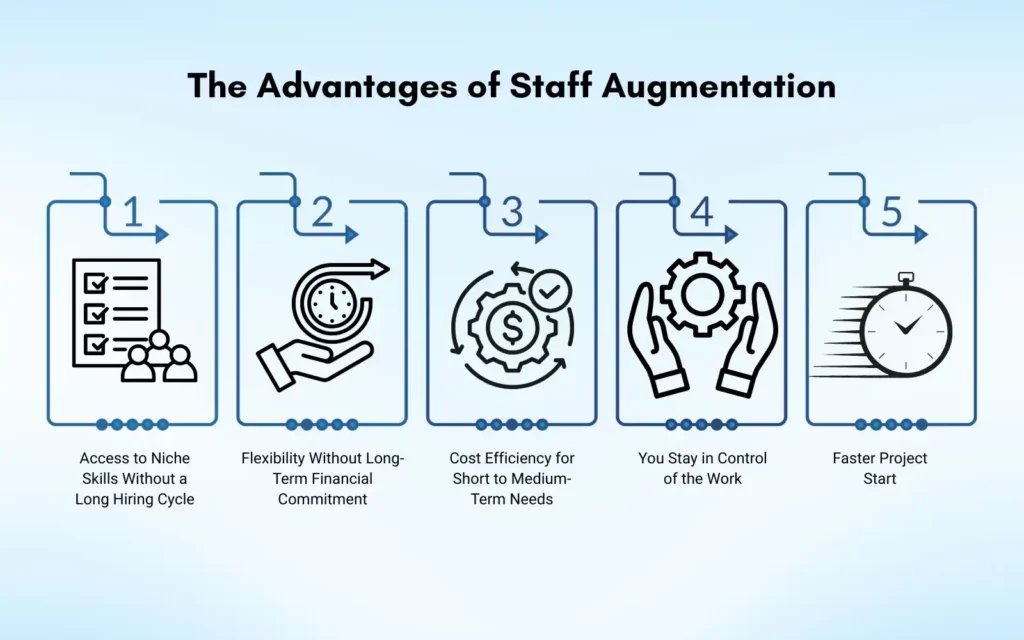
1. Access to Niche Skills Without a Long Hiring Cycle
Finding a senior DevSecOps engineer or an AI integration specialist through traditional hiring takes months. Staff augmentation gets you access to pre-vetted professionals in days. A good partner maintains an active bench — screened, tested, and ready to deploy.
For projects with defined timelines or rapidly shifting skill needs, that speed is genuinely valuable.
2. Flexibility Without Long-Term Financial Commitment
Permanent hires come with fixed costs — salary, benefits, notice periods. Staff augmentation lets you scale up for a sprint and scale back when it ends. You match headcount to actual workload rather than carrying permanent overhead for work that is not always there.
3. Cost Efficiency for Short to Medium-Term Needs
Augmentation is not always cheaper than permanent hiring. But factor in recruiting time, onboarding, benefits, and employer contributions — and the comparison shifts. A senior developer hired permanently for a six-month migration almost always costs more than augmenting for that period.
Our breakdown of how staff augmentation saves time and costs in IT projects covers this in more detail.
4. You Stay in Control of the Work
You set the priorities. You run the standups. You review the output. Augmented professionals plug into your sprint cycles and report to your team leads — not to a vendor project manager. For leaders who have had outsourcing go sideways, this level of control is usually what makes augmentation the preferred model.
5. Faster Project Start
When your team lacks capacity or a specific skill and a project needs to start soon, augmentation is often the fastest path. You are not waiting on job boards, interviews, or notice periods. The right professional can be onboarded and contributing within days of sign-off.
The Disadvantages of Staff Augmentation
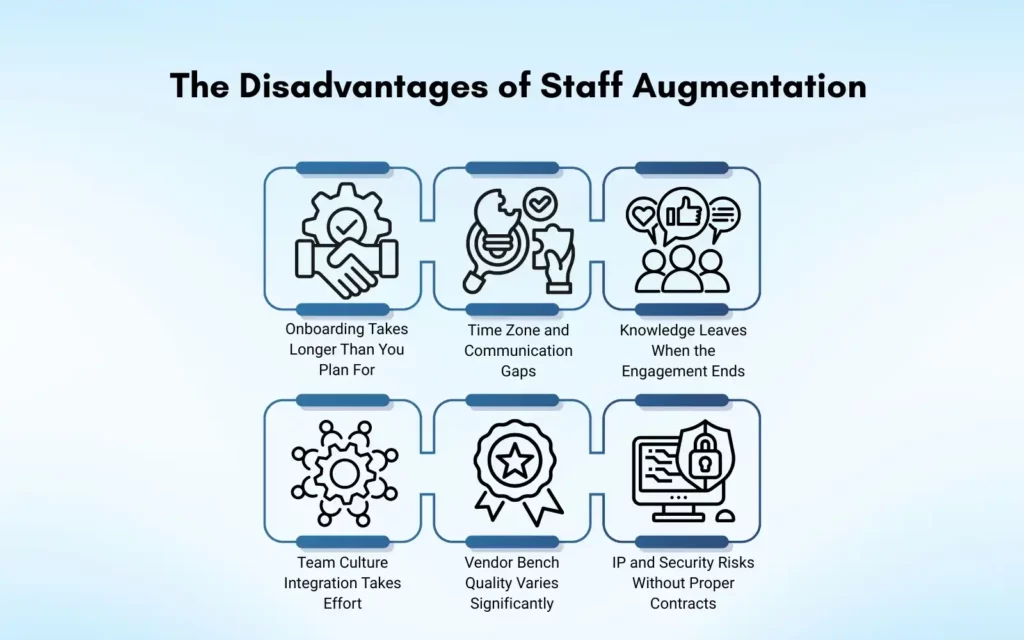
Most vendor-written guides skip this section. These are real challenges that affect real projects.
1. Onboarding Takes Longer Than You Plan For
Every new person needs time to understand your codebase, tooling, and team norms. This is not unique to augmentation — but IT leaders often forget to factor it in. Expect a two to four week ramp-up before an augmented professional is contributing at full capacity. In short engagements, that is a significant chunk of the timeline.
2. Time Zone and Communication Gaps
Cross-timezone augmentation comes with coordination overhead. Delayed responses, missed context, and asynchronous reviews slow delivery in ways that are easy to underestimate when signing a contract. It is manageable — with defined overlap hours and clear SLAs — but it needs active management, not passive hope.
3. Knowledge Leaves When the Engagement Ends
An augmented professional working on your platform for six months accumulates institutional knowledge. When the engagement ends, that knowledge goes with them unless you have built knowledge transfer into the engagement from day one. Most teams only think about this at offboarding. That is too late.
Documentation habits, structured handovers, and code commenting standards need to be set at the start, not the end.
4. Team Culture Integration Takes Effort
Augmented professionals sometimes sit on the periphery of team culture. They may not engage in the informal conversations that shape team norms or feel the same product ownership as permanent staff. Some teams integrate augmented professionals seamlessly. Others do not. Either way, it requires deliberate effort — including them in rituals, giving them context, and treating them as actual team members.
5. Vendor Bench Quality Varies Significantly
Your results depend almost entirely on who your vendor places. A strong partner maintains a vetted bench and can deploy the right person quickly. A weaker one recruits on demand after you sign and sends whoever is available. The model looks very different depending on which kind of vendor you are working with.
Our guide on how to choose an IT staff augmentation company covers exactly what to ask about bench strength before you sign.
6. IP and Security Risks Without Proper Contracts
Augmented professionals access your codebase, data, and sometimes client information. Without proper contracts — individual NDAs, explicit IP ownership clauses, documented data security compliance — that access creates real exposure. Most of this risk is preventable. The problem is that SMB IT leaders often do not review contracts carefully enough before work starts.
Non-negotiables: individual NDA coverage, IP ownership explicitly assigned to you, and data security compliance documentation before anyone logs in.
When the Model Works Well
Staff augmentation consistently delivers when:
The project has defined scope and a clear end date. A migration, a product sprint, a platform upgrade — engagements with boundaries suit the model well. Open-ended, ambiguous work is much harder to staff augment successfully.
You have internal technical leadership to manage the work. The model provides execution capacity, not strategic direction. Someone on your team needs to own the work and direct the professional day to day.
The skill requirement is specific and the vendor has verifiable professionals in that exact skill — not a promise to find someone post-contract. Always ask to see the bench before you sign.
Communication expectations are set upfront. Overlap hours, response SLAs, and a named point of contact on the vendor side should be in the contract, not discussed informally after onboarding begins.
When the Model Causes Problems
Staff augmentation consistently fails when:
There is no internal leadership to manage the augmented professional. Without direction, execution stalls.
The project scope is unclear. A poorly defined engagement produces mismatched output regardless of the professional’s skill level.
The engagement is too short to absorb onboarding. Below roughly six weeks, the ramp-up cost makes the economics and delivery quality both suffer.
It is being used as a substitute for building a real team. Augmentation is a bridge, not a foundation. Sustained over-reliance creates compounding vendor dependency and knowledge retention problems.
If you are weighing augmentation against managed services, our comparison of IT staff augmentation vs managed services covers when each model fits better.
Pros and Cons at a Glance
| Factor | Advantage | Disadvantage |
| Talent access | Pre-vetted specialists, fast deployment | Quality depends on vendor bench strength |
| Cost | Efficient for short to medium-term needs | Can exceed permanent hire cost for long engagements |
| Flexibility | Scale up and down without long-term obligation | Mid-project scale-down can disrupt delivery |
| Control | You manage the work directly | Requires internal management capacity |
| Speed | Faster start than a permanent hire | Ramp-up reduces output in early weeks |
| Knowledge | Fresh skills and external perspective | Leaves with the professional at engagement end |
| Integration | Seamless with the right approach | Requires deliberate effort — not automatic |
| IP and security | Manageable with proper contracts | Real risk without individual NDA and IP clauses |
The Bottom Line
Staff augmentation works well when the scope is clear, internal leadership is in place, and the vendor has genuine bench quality. It creates problems when any of those three conditions are missing.
The teams that struggle with the model almost always trace it back to one of two things: the wrong vendor or the wrong situation. Neither is a flaw in the model — both are execution problems with known solutions.
Getting vendor selection right is the single highest-leverage decision in any augmentation engagement. The professional your vendor places will determine your experience more than any other factor. Ask about their bench, their vetting process, and their replacement policy before you sign anything. Those three questions will tell you most of what you need to know.
Want to understand what a well-structured engagement looks like for your team? Betatest Solutions is happy to walk you through it — no commitment, just clarity.
Explore Betatest Solutions Staff Augmentation Services →
Frequently Asked Questions
Knowledge loss at the end of an engagement. If knowledge transfer is not built into the process from day one, the institutional knowledge an augmented professional builds over months walks out with them.
For engagements under 12 months, usually yes when total hiring costs are factored in. Beyond 12 to 18 months, the economics often favour a permanent hire.
Two to four weeks is realistic for most environments. Plan for it upfront rather than treating it as a delay.
Yes — but it requires defined overlap hours, clear communication protocols, and a named vendor-side point of contact. Remote augmentation without those structures consistently underperforms.
Individual NDA coverage, explicit IP ownership assigned to you, data security compliance documentation, and a scale-down notice period of 30 days or less.
When you do not have the internal capacity to manage the work directly. Outsourcing hands delivery responsibility to the vendor. Augmentation keeps it with you.