

You brought in an IT staff augmentation vendor. Onboarding took three weeks instead of five days. The developer they sent had the right title on paper but struggled with your actual stack. By the time you decided to request a replacement, you were six weeks behind schedule and had already paid for time that delivered almost nothing.
This is not an edge case. It is one of the most common experiences SMB owners report after choosing a staff augmentation partner the wrong way — based on a polished pitch deck, a low hourly rate, or a promise that they “cover everything.”
The good news: every single one of these problems is preventable. Not with luck, but with the right questions asked before you sign anything.
This blog gives you a 7-point checklist built specifically for small and mid-sized businesses — owners who do not have a procurement team or a legal department to catch the gaps. Work through each point before your next vendor conversation, and you will make a decision you can stand behind.
What Is IT Staff Augmentation — and Why SMBs Get It Wrong
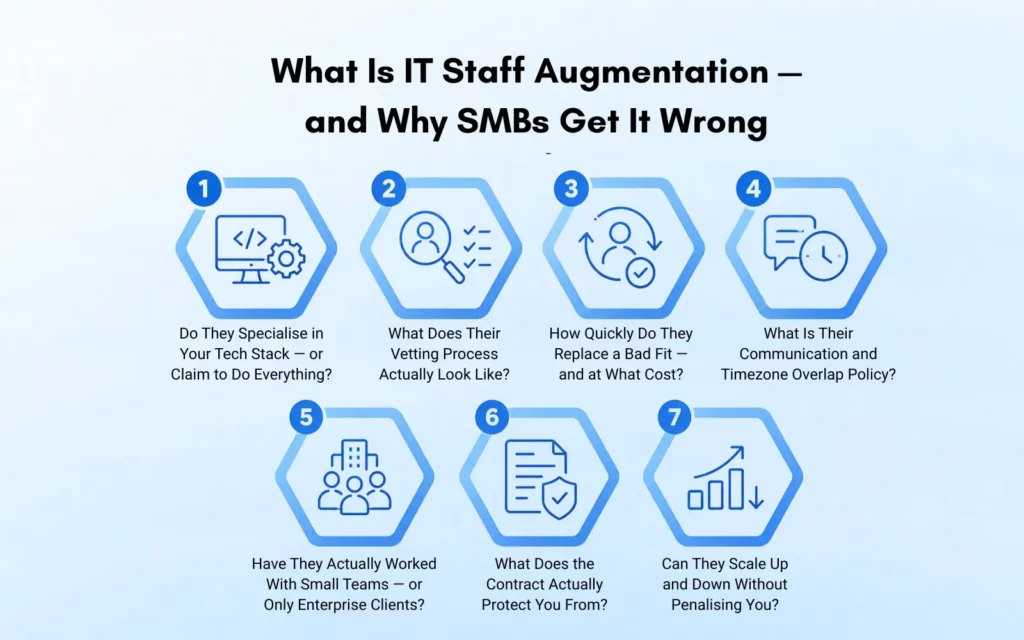
Before we get into the checklist, a quick grounding. IT staff augmentation is a model where you bring in external developers, QA engineers, designers, or other tech professionals to work as part of your existing team — on your tools, your timelines, your processes. Unlike outsourcing, you stay in control of the work. Unlike hiring full-time, you stay flexible on headcount.
The model works exceptionally well when matched with the right vendor. When matched with the wrong one, it creates exactly the kind of drag that kills project momentum for smaller teams.
The problem most SMBs face is that they evaluate vendors the same way they would evaluate a freelancer — based on portfolio and price. Staff augmentation vendor evaluation requires a completely different lens. Here is how to do it properly.
1. Do They Specialise in Your Tech Stack — or Claim to Do Everything?
The first red flag to look for is on the vendor’s own website. If their services page lists 40 technologies across 12 domains — from blockchain to embedded systems to UI/UX — that is not range. That is a signal they will find someone after you sign, not before.
A legitimate IT staff augmentation company for small business clients maintains a pre-vetted bench of specialists. That means developers who have already been screened, tested, and graded — not recruited on demand once your contract is in place.
What to ask:
- Can you show me three recent placements specifically in [your stack — e.g., React, Node.js, Python, .NET]?
- How many professionals in this skill set are currently on your bench?
- What is your average time-to-deploy for this profile?
If the answers are vague or heavily qualified, treat that as a skills gap they are hoping you will not notice until it is too late. Bench strength in your specific stack is non-negotiable.
2. What Does Their Vetting Process Actually Look Like?
This is the question most SMB owners never think to ask — and the one that separates good vendors from expensive mistakes.
Resume shortlisting is not vetting. A proper internal screening process for a right staff augmentation partner should include at minimum: a structured technical assessment, a code or work-sample review, a communication evaluation, and a final human interview by someone with domain expertise. Not just an HR screen.
What to ask:
- Walk me through your internal screening process step by step.
- Who designs and reviews the technical assessments — is it internal engineers or outsourced?
- Can I review the test format or assessment criteria before we engage?
- What percentage of applicants make it through your full vetting process?
A vendor who cannot answer these questions in specific terms is telling you something important: their “vetting” is surface-level. You will be doing your own quality control after they place someone — on your budget and your clock.
3. How Quickly Do They Replace a Bad Fit — and at What Cost?
This is the clause SMBs discover too late, buried in section 8 of a contract they signed without reading carefully.
Every IT staff augmentation engagement will occasionally result in a mismatch. A professional who looked right on paper does not gel with your team’s working style, communication rhythm, or technical depth. What matters is not whether that happens — it will — but how fast the vendor fixes it and who bears the cost.
What to ask:
- What is your replacement guarantee — timeline and process?
- Is there a cost to me for a replacement during a trial period?
- How long is your standard trial window before a replacement becomes chargeable?
- Do I need to document the underperformance, or is my word enough to trigger the process?
Any vendor worth working with will have a clear, written, plain-English answer to all of these. If the response is “we handle it case by case” or “our team will evaluate the situation,” that is not a policy. That is a negotiation you will lose when you are already frustrated and behind schedule.
IT staff augmentation risks are largely manageable — but only when the replacement clause protects you, not the vendor.
4. What Is Their Communication and Timezone Overlap Policy?
Communication gaps do not just slow projects down. For small teams without redundancy, a single unresponsive developer or a vendor-side point of contact who is unavailable during your working hours can bring a sprint to a complete stop.
This is especially true for SMBs working with India-based IT staff augmentation companies, where timezone overlap with European or US-based clients needs active management, not passive hope.
What to ask:
- Is there a dedicated account manager or point of contact on your side — separate from the developer?
- What are the guaranteed overlap hours between my team and the augmented staff?
- What is your response time SLA for urgent issues during business hours?
- If something goes wrong at 9am my time, who do I call and how long before I hear back?
The answer to “who do I call” is particularly revealing. If the answer is “the developer directly,” that means there is no vendor-side accountability layer. For an SMB that cannot afford project delays, that is a structural problem dressed as a feature.
You can read more about how IT services can be structured to support operational efficiency in our blog on streamlining business operations with IT services.
5. Have They Actually Worked With Small Teams — or Only Enterprise Clients?
This distinction matters more than most SMB owners realise until they are six weeks into an engagement that feels like trying to move fast while dragging an anchor.
Vendors built primarily for enterprise clients have processes designed for large teams — lengthy onboarding documentation, multi-week approval cycles, layered management structures, and compliance frameworks built for 500-person organisations. When those processes are applied to a 10-person SMB that needs to move in days, not weeks, the friction is enormous.
What to ask:
- What percentage of your current clients are SMBs versus enterprise?
- Can you share references from clients with team sizes similar to mine?
- How do you adapt your onboarding process for smaller teams with faster turnaround needs?
- What is the smallest team you have successfully augmented in the last 12 months?
The goal is not to find the biggest vendor. It is to find the right staff augmentation partner for your size, speed, and working style. A vendor who primarily serves enterprises and calls you a “strategic SMB client” is probably giving you an enterprise workflow with a smaller contract value.
For context on how staff augmentation compares to managed services for different business sizes, see our breakdown of IT staff augmentation vs managed services.
6. What Does the Contract Actually Protect You From?
Many SMBs treat the contract as a formality. It is not. It is the only document that protects you when the relationship goes sideways — and in IT staff augmentation, the contracts are where vendors often have the advantage, because they write them every day and you sign them once every few years.
There are four non-negotiables every SMB must verify before signing:
IP Ownership — All code, designs, documentation, and work product created during the engagement must belong to you, not the vendor or the individual professional. This should be explicitly stated, not implied.
NDA Coverage — The NDA must cover both the vendor organisation and every individual placed with your team. A vendor-level NDA that does not bind individual contractors is a gap.
Notice Period — The standard range is 30 to 60 days. Be cautious of contracts that lock you into 90-day notice periods for scale-down — that is not flexibility, that is a trap. Push for 30 days.
Data Security Compliance — If your product handles any customer data, the vendor must be able to demonstrate compliance with relevant standards (ISO 27001, SOC 2, GDPR depending on your market). Ask for documentation, not verbal assurance.
A useful read alongside this: our post on QA staff augmentation for enterprises covers how professional augmentation partnerships handle accountability — worth reviewing even if you are not specifically hiring QA.
7. Can They Scale Up and Down Without Penalising You?
Flexibility is the entire value proposition of staff augmentation. If the contract does not actually deliver that flexibility, you have paid a premium for a model that behaves like a fixed hire.
Scaling up is rarely the issue — most vendors are happy to add headcount when you need more. Scaling down is where SMBs get caught. A project ends, a funding round is delayed, a product direction changes — and suddenly you are locked into paying for three developers for another 90 days because of a minimum headcount clause buried in the agreement.
What to ask:
- What is the minimum engagement commitment in terms of headcount and duration?
- If I need to scale from 4 developers to 2, what is the process and notice period?
- Are there financial penalties for scaling down before a certain milestone?
- Can I pause the engagement rather than terminate if I hit a project gap?
The answers to these questions tell you more about a vendor’s values than any case study or testimonial will. A vendor who sees you as a long-term partner makes scaling down easy because they know you will scale back up. A vendor who sees you as a contract to extract value from will make it as difficult as possible.
For a deeper comparison of engagement models, our blog on staff augmentation vs outsourcing breaks down when each model actually makes sense for growing teams.
Your 7-Point IT Staff Augmentation Vendor Checklist
Before your next vendor conversation, run through these:
- They have pre-vetted professionals specifically in your tech stack — not a promise to find someone
- Their internal screening process is documented, multi-stage, and they can explain it in detail
- They have a written replacement guarantee with a clear timeline and no penalty to you
- There is a dedicated point of contact on their side with defined response SLAs
- They have verifiable experience working with SMB-sized teams, not just enterprise clients
- The contract explicitly covers IP ownership, individual NDAs, a 30-day notice period, and data security compliance
- Scale-down is possible without financial penalties and without a 90-day lock-in
Print this. Use it in every vendor call. Share it with whoever else is part of the decision.
The Right Partner Changes Everything
Choosing the wrong IT staff augmentation vendor is expensive — not just in money, but in time, team morale, and project momentum. Choosing the right one means your product moves faster, your team stays focused, and your headcount stays as flexible as your business needs it to be.
If you want to understand how Betatest Solutions approaches staff augmentation for growing teams — including how we screen talent, structure engagements, and support SMBs specifically — we are happy to walk you through it. No commitment, just clarity.
Explore Betatest Solutions Staff Augmentation Services →
Frequently Asked Questions
Choosing based on price alone. Hourly rate is one of the least reliable indicators of quality in staff augmentation. A cheap vendor who places the wrong person, takes three weeks to replace them, and has no SLA on communication will cost you far more than a slightly higher rate from a vendor with genuine bench strength and accountability built into the contract.
With a well-prepared vendor and a clear brief from your side, a professional should be operationally productive within 5 to 10 business days. If a vendor quotes you 3 to 4 weeks as standard onboarding, ask exactly what is happening during that time — that timeline usually signals process inefficiency on their end, not complexity on yours.
It can work, but it requires extra care during vendor selection. Without an internal technical lead to evaluate candidate quality and guide the augmented professional, you are more dependent on the vendor’s vetting process being rigorous. In this scenario, ask specifically whether the vendor provides any technical oversight or project lead support as part of the engagement.
Two to four weeks is standard and fair for both sides. During the trial, you should be able to evaluate communication quality, technical output, and cultural fit within your team. Any vendor unwilling to offer a trial period — or who charges full penalty rates for ending during trial — should be treated with caution.
In staff augmentation, you manage the work directly. The professionals integrate into your team, follow your processes, and report to you. In outsourcing, you hand over a deliverable and the vendor manages how it gets done. For SMBs that want speed and control without the overhead of full-time hiring, augmentation is usually the better fit. You can read our full comparison here: staff augmentation vs outsourcing.
Four things must be explicit: IP ownership belongs to you, NDAs cover individual contractors not just the vendor company, the notice period is 30 days or less for scale-down, and data security compliance is documented — not verbal. Do not sign until all four are confirmed in writing.