

Performance Marketing vs Brand Marketing: Which Strategy Fits Your IT Services Business?
Your IT services firm has Rs. 2 lakh a month for marketing. Do you spend it on Google Ads and LinkedIn lead gen campaigns — where every rupee is tracked and every lead is counted? Or do you invest in content, thought leadership, and brand presence — where the returns are real but harder to measure on a spreadsheet?
This is not a theoretical question. It is the decision that founders, business development heads, and marketing managers at staff augmentation firms, software development companies, and SharePoint consultancies are making right now — often without a clear framework to guide them.
The short answer: neither strategy wins by default. The right choice depends on your business stage, your sales cycle length, and whether you are trying to generate pipeline this quarter or build credibility over the next three years. This guide gives you a practical framework to decide — with a decision table, real scenarios, and a look at where most IT services companies go wrong.
What Each Strategy Actually Means for an IT Services Company
Both terms get used loosely, so it is worth grounding them in IT services context before comparing them. If you want a deeper breakdown of what performance marketing is and how it works for IT companies, that is covered separately. Here, the focus is on how each approach plays out in a B2B IT services environment.
Performance marketing in IT services means running campaigns where you pay for measurable outcomes — a LinkedIn lead gen form submission, a Google Ads click to your staff augmentation service page, a demo booked through a retargeting ad. Every campaign has a cost-per-lead number attached to it, and you can tell at the end of the month whether the spend was worth it.
Brand marketing in IT services means building your company’s reputation and recognition over time — through thought leadership articles, industry webinars, consistent social media presence, case study content, and earned media. The goal is to be the company that potential clients already know and trust by the time they are ready to buy.
The key difference: Performance marketing generates demand that already exists. Brand marketing creates demand that did not exist before — by shaping how your target clients perceive your firm before they are even actively looking.
When Performance Marketing Works Best for IT Services
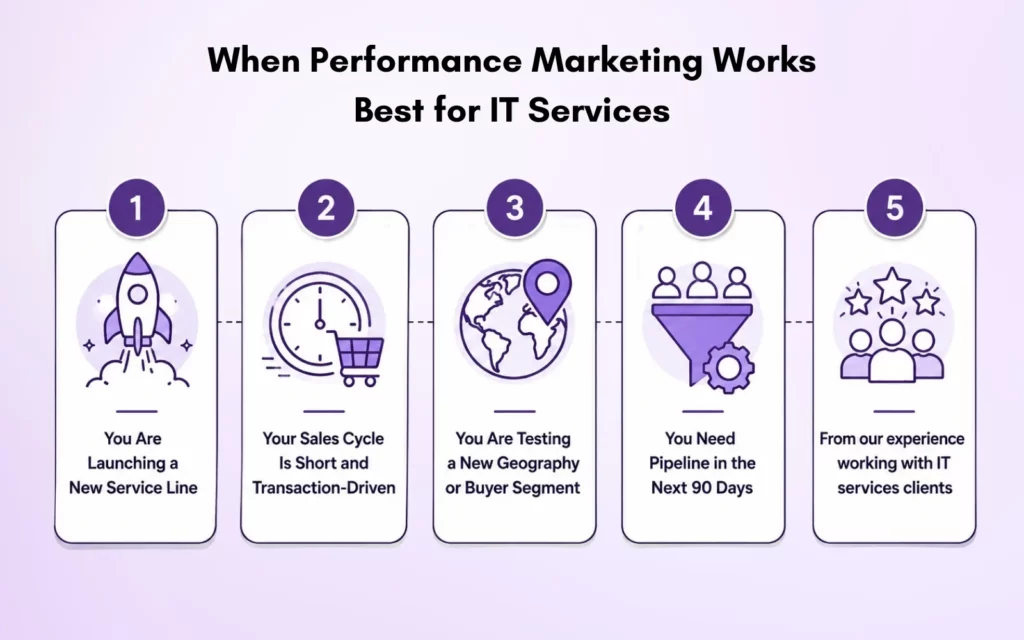
Performance marketing is the right primary investment when speed and measurability matter more than scale. Here are the specific scenarios where it delivers best for IT services companies:
1. You Are Launching a New Service Line
If your firm launches a new offering — say, an AI integration service or a SharePoint migration package — performance marketing is the fastest way to validate whether there is demand. A targeted LinkedIn campaign to CTOs and IT heads can generate qualified conversations within weeks, not months. You get real market feedback before committing to a larger brand investment around that service.
2. Your Sales Cycle Is Short and Transaction-Driven
Staff augmentation for smaller projects — filling a QA engineer slot for three months, for example — often has a shorter decision cycle than enterprise software development. When the buyer knows what they want and is evaluating options, being visible in search and on LinkedIn at the right moment matters more than brand recognition. Performance marketing captures that intent precisely.
3. You Are Testing a New Geography or Buyer Segment
Before building brand presence in a new market — say, targeting mid-market US companies for offshore development — performance marketing lets you test messaging, pricing, and positioning with real spend. You discover what resonates and what does not before committing to a longer brand-building programme.
4. You Need Pipeline in the Next 90 Days
This is the most common situation. When the business development pipeline is thin and leadership needs new conversations started quickly, performance marketing is the tool. It does not build lasting equity, but it generates activity when you need it.
From our experience working with IT services clients: LinkedIn Lead Gen Forms targeting by company size and job title consistently outperform Google Search for staff augmentation leads. Google works well for comparison and “what is” queries — LinkedIn wins when you are targeting a specific buyer persona who is not actively searching yet.
When Brand Marketing Works Best for IT Services
Brand marketing is the right primary investment when you are playing a longer game — when the deals you are chasing are larger, the competition is established, and trust is the deciding factor.
1. You Are Competing for Enterprise Contracts
Enterprise IT procurement is rarely won by whoever ran the best ad last month. It is won by the firm that the procurement team has heard of, seen quoted in articles, and encountered at industry events. A CTO evaluating SharePoint consulting vendors is going to research the shortlisted firms carefully. Your content footprint — case studies, published perspectives, media mentions — is your audition. Performance marketing gets you into the room; brand marketing determines whether you win the deal.
2. Your Sales Cycle Is 6 Months or Longer
Enterprise software development engagements, large-scale AI integration projects, and long-term staff augmentation contracts all involve extended evaluation periods. A prospect who sees your firm’s thought leadership content consistently over six months comes into the sales conversation with a level of trust that no retargeting ad can create. Brand marketing compounds across that timeline in a way performance marketing cannot.
3. You Are Differentiating in a Crowded Market
The IT services market in India is extremely crowded. Hundreds of firms offer staff augmentation, custom software development, and Microsoft technology consulting. When the services are similar, differentiation comes from brand — your unique methodology, your team’s expertise, your visible client outcomes. According to LinkedIn’s B2B Marketing Benchmark report, 77% of B2B buyers say thought leadership content makes them more confident in choosing a vendor. That confidence does not come from a paid ad.
If you are choosing the right IT services marketing partner in India, one of the clearest signals of a strong partner is whether they can support both performance campaigns and brand content — not just one or the other.
The Real Question: Business Stage and Budget, Not Either/Or
The mistake most IT services companies make is treating this as a binary choice — either we do performance marketing or we do brand building. The firms that grow consistently do both, with a ratio that shifts as the business matures.
Here is a practical budget mix framework based on business stage:
| Business Stage | Recommended Budget Split | Primary Goal | Why This Mix |
| Early-Stage IT Firm (0–3 yrs, <Rs. 5Cr revenue) | 80% Performance / 20% Brand | Generate qualified leads fast | You need pipeline, not awareness. Prove ROI before investing in brand. |
| Growth-Stage IT Company (3–7 yrs, scaling team) | 55% Performance / 45% Brand | Shorten sales cycles, build recognition | Prospects are Googling you now. What they find matters as much as the ad. |
| Established IT Services Brand (7+ yrs, enterprise clients) | 35% Performance / 65% Brand | Protect margin, attract premium clients | Enterprise deals are won on reputation and referral, not ad spend. |
The ratio shifts as you grow — but neither line should ever go to zero. Even early-stage IT firms should maintain some brand presence (a consistent LinkedIn voice, published case studies), because prospects research you even when they find you through an ad.
The other variable is deal size. If your average contract value is above Rs. 50 lakh, brand marketing almost always has a higher long-term ROI — because the trust required to close those deals cannot be manufactured by a campaign. If your average contract is Rs. 5–10 lakh and the buyer is decisive, performance marketing will outperform.
5 Signs Your IT Services Company Is Spending on the Wrong Strategy
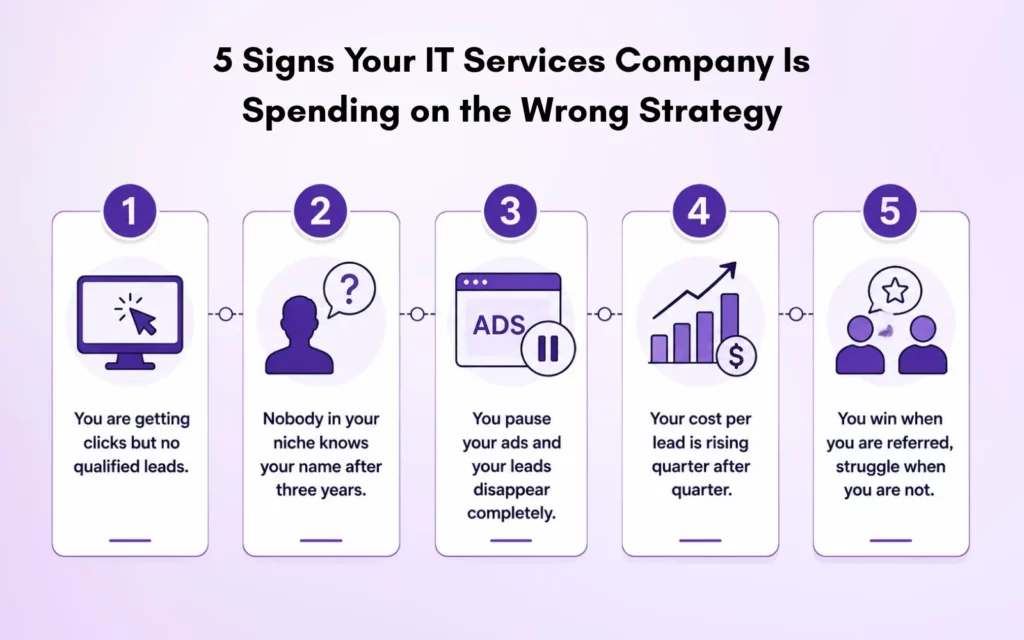
These are patterns that come up repeatedly in IT services marketing. If you recognise your firm in more than two of these, it is worth reviewing your current allocation.
1. You are getting clicks but no qualified leads. Your campaigns are generating activity, but leads are not converting to conversations. This usually means performance marketing is running but your brand presence is not strong enough to build the credibility needed to convert a warm lead. Prospects click, look at your website, find nothing that builds trust, and leave.
2. Nobody in your niche knows your name after three years. If potential clients are still encountering your firm for the first time at the proposal stage, you have underinvested in brand. In a services business, recognition reduces sales resistance significantly.
3. You pause your ads and your leads disappear completely. This is the classic symptom of 100% dependence on performance marketing. If your pipeline stops the moment your ad spend stops, you have no compounding brand asset. Performance marketing rents attention; brand marketing owns it.
4. Your cost per lead is rising quarter after quarter. As competition for IT services keywords and LinkedIn audiences increases, performance marketing costs go up. Firms that build brand in parallel see their cost per lead stabilise or fall over time — because warm, brand-aware prospects convert at higher rates and lower cost.
5. You win when you are referred, struggle when you are not. Referrals are a proxy for brand strength. If you close almost every referred lead but lose most cold-approach deals, your brand is strong within your existing network but weak with unfamiliar buyers. Brand marketing extends that trust beyond your immediate circle.
Not sure which mix is right for your IT services business? At Betatest Solutions, we work with IT services companies — from staff augmentation firms to enterprise software development shops — to build marketing strategies that match their business stage, deal size, and growth goals. Explore our digital marketing services for IT companies or get in touch directly.
Frequently Asked Questions
Performance marketing targets buyers who are already looking for IT services — through search ads, LinkedIn campaigns, and retargeting. It generates measurable leads with a trackable cost per acquisition. Brand marketing builds your firm’s reputation and recognition over time through content, thought leadership, and consistent visibility — so that when a prospect is ready to buy, your firm is already familiar and trusted. The difference is immediacy versus compounding: performance marketing works now, brand marketing works over time.
Neither is universally better. For early-stage IT firms that need pipeline quickly, performance marketing delivers faster results. For established firms competing for larger enterprise contracts, brand marketing has a higher long-term ROI because trust is the deciding factor in high-value B2B procurement. Most IT services companies benefit from both — with the ratio shifting from performance-heavy early on to brand-heavy as the business matures and average deal size increases.
A practical starting framework: early-stage IT firms (0–3 years) should allocate roughly 80% to performance marketing and 20% to brand building. Growth-stage firms (3–7 years) should move toward a 55/45 split. Established IT services brands competing for enterprise contracts often invert the ratio — 35% performance, 65% brand. The right split depends on your average deal size, sales cycle length, and how well-known your firm is in your target market.
Yes — brand marketing does not require a large budget. The most effective brand investments for small IT services firms are low-cost and high-credibility: publishing detailed case studies, writing bylined articles on LinkedIn, speaking at industry webinars, and building a consistent content presence around your specific area of expertise. A staff augmentation firm that publishes genuinely useful content about IT hiring challenges every two weeks builds more brand credibility than a large firm running generic ads. The constraint is not budget; it is consistency.
LinkedIn Lead Gen Forms targeting by job title, company size, and industry consistently outperform Google Search for IT services lead generation — particularly for staff augmentation and enterprise consulting. Google Search works well for capturing active buyers searching comparison queries (e.g. “staff augmentation vs outsourcing”) and cost-related queries (e.g. “IT staff augmentation pricing”). Retargeting campaigns on LinkedIn that serve case study content to previous website visitors bridge the gap between performance and brand — warming up leads who have already shown intent.