

Performance Marketing: Strategy, ROI & Product Launch Guide
Introduction
Performance marketing is now the standard for businesses that need measurable returns from every rupee or dollar spent. In 2026, with the global digital advertising market expected to surpass $650 billion, marketing teams face more pressure than ever to prove impact — not just reach.
A critical question still divides marketing leaders: should you invest in a performance marketing strategy or stick with traditional marketing? And once you commit to a digital performance marketing approach, how do you actually execute a successful product launch with it?
This guide answers both. It covers what performance marketing is, which performance marketing channels deliver the strongest results, how it compares to traditional marketing on real ROI metrics, and gives you a step-by-step product launch execution framework — backed by real-world case studies from brands that got it right.
What Is Performance Marketing?
Performance marketing is a results-driven digital marketing model where advertisers pay only for specific, measurable outcomes — not for ad placements or impressions. Those outcomes include:
- Clicks
- Leads
- Sales
- App installs
- Sign-ups
The model emerged in the mid-1990s with pay-per-click (PPC) advertising and has since expanded across every major digital channel. Unlike brand marketing — which focuses on long-term awareness — digital performance marketing ties every rupee directly to a trackable action, making continuous optimisation not just possible but built into the process.
Core Performance Marketing Channels
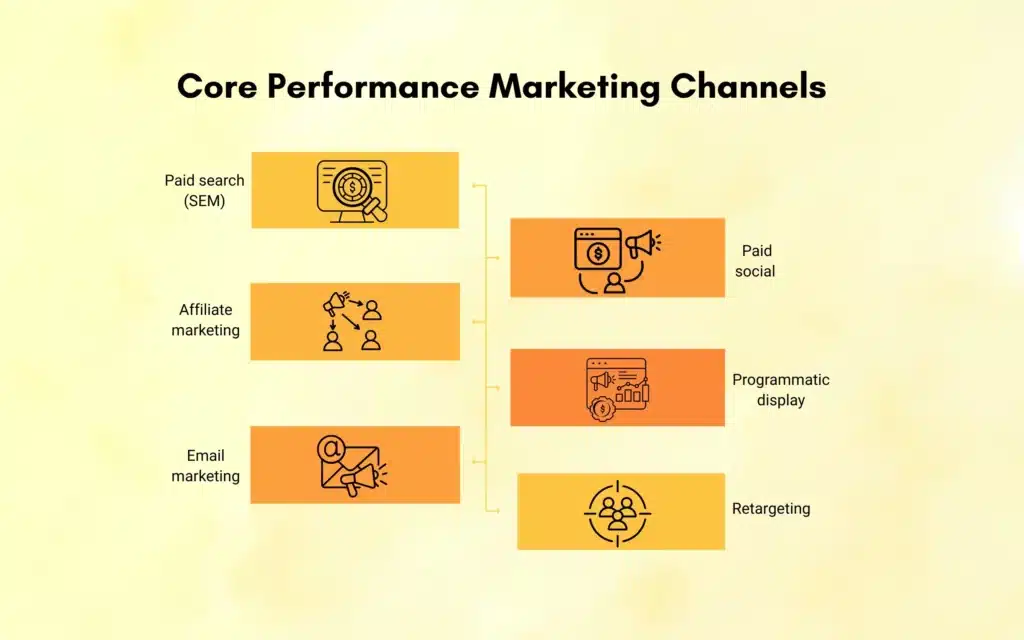
Choosing the right performance marketing channels is one of the most important strategic decisions in any campaign:
- Paid search (SEM) — Google Ads and Bing Ads targeting high-intent keywords at the moment users are actively searching for solutions
- Paid social — Facebook, Instagram, LinkedIn, and TikTok campaigns with precise demographic and behavioural targeting
- Affiliate marketing — commissions paid only on sales or leads driven by partner websites or influencers
- Programmatic display — automated ad buying algorithmically optimised for conversions rather than impressions
- Email marketing — targeted, segmented campaigns that nurture warm leads through the consideration and decision phases
- Retargeting — re-engaging users who interacted with your brand but didn’t convert, typically at a lower CPA than cold acquisition
Practical example: A brand selling organic skincare allocates ₹80,000/month on Google Ads targeting “natural soap” and “organic face wash.” By tracking which keywords drive actual purchases versus which only generate clicks, they continuously shift budget toward converting terms — eliminating wasted spend entirely.
Our digital marketing services are built around exactly this kind of accountable, data-driven performance marketing strategy.
Performance Marketing vs Traditional Marketing: ROI Compared
The fundamental difference between performance marketing vs brand marketing — and performance marketing vs traditional marketing — is accountability. Performance marketing ties spend to outcomes. Traditional marketing ties spend to exposure.
This distinction has significant implications for how budgets are justified, allocated, and optimised.
Comparison Table: Performance Marketing vs Traditional Marketing
| Category | Performance Marketing | Traditional Marketing |
| Primary objective | Conversions and measurable actions | Brand awareness and reach |
| Measurement | Real-time, data-driven metrics | Delayed or estimated metrics |
| ROI visibility | High and transparent | Limited and indirect |
| Cost structure | Pay-for-performance | Fixed, upfront costs |
| Optimisation speed | Continuous and fast | Slow or post-campaign |
| Risk level | Lower — flexible budgets | Higher — sunk costs |
| Scalability | Highly scalable | Limited by media slots |
| SEO / organic benefit | Yes | No |
| Attribution accuracy | High | Low |
| Best use cases | Growth, lead gen, sales, launches | Brand building, mass awareness |
What the Data Shows on Traditional vs Digital Marketing ROI
The evidence consistently favours performance-led models for measurable ROI:
- Gartner research shows data-driven marketing organisations are 3x more likely to improve ROI year over year compared to those relying on traditional methods
- McKinsey reports that analytics-driven marketing improves ROI by 15–20% compared to industry peers
- Traditional media planning relies on CPM estimates and post-campaign surveys; performance marketing metrics like CPA and ROAS give real-time visibility that makes budget justification straightforward
Where Traditional Marketing Still Delivers
Despite the ROI advantage of digital performance marketing, traditional marketing is not obsolete. It remains effective for:
- Emotional brand storytelling at mass scale
- Awareness campaigns in markets where digital penetration is lower
- Television during major events and sponsorships with broad demographic reach
- Industries where offline channels still dominate consumer attention and trust
The core limitation remains measurement — attribution is indirect, delayed, and frequently estimated rather than tracked.
When to Choose Which Approach
Choose a performance marketing strategy when:
- ROI accountability is required by finance or leadership
- Budgets need to flex based on real-time results
- Speed of testing and iteration matters
- Conversion tracking across the funnel is possible
Choose traditional marketing when:
- Brand awareness is the primary objective
- Market education is required before purchase intent exists
- Long-term brand positioning and emotional connection are the goals
The most effective 2026 approach: hybrid. The highest-performing organisations use performance marketing for acquisition and conversion, and traditional or brand marketing for awareness and trust-building. Brand-aware audiences consistently convert at lower CPA on performance channels — meaning traditional investment directly improves performance marketing efficiency.
Working with an experienced performance marketing agency helps businesses find the right balance between these approaches for their specific growth stage.
Key Performance Marketing Metrics to Track
Understanding performance marketing metrics is essential whether you’re running ongoing acquisition campaigns or a time-sensitive product launch. These are the numbers that drive decisions:
| Metric | What It Measures |
| CPA (Cost Per Acquisition) | Cost to acquire one paying customer |
| ROAS (Return on Ad Spend) | Revenue generated per rupee spent on ads |
| CTR (Click-Through Rate) | Ad relevance and creative effectiveness |
| CAC (Customer Acquisition Cost) | Total marketing cost per new customer including all overheads |
| CLV (Customer Lifetime Value) | Predicted total revenue from a single customer relationship |
| Conversion Rate | Percentage of visitors completing the desired action |
| NPS (Net Promoter Score) | Customer satisfaction and likelihood to recommend |
| Time to Break Even | Duration until campaign revenue covers total investment |
| Market Share | Proportion of total market sales captured |
| Customer Churn Rate | Rate at which customers stop purchasing or using the product |
A strong performance marketing strategy optimises not just for CPA in isolation, but for the relationship between CAC and CLV — ensuring the cost of acquiring customers is justified by the long-term value they generate.
How to Use Performance Marketing for a Product Launch: Step-by-Step
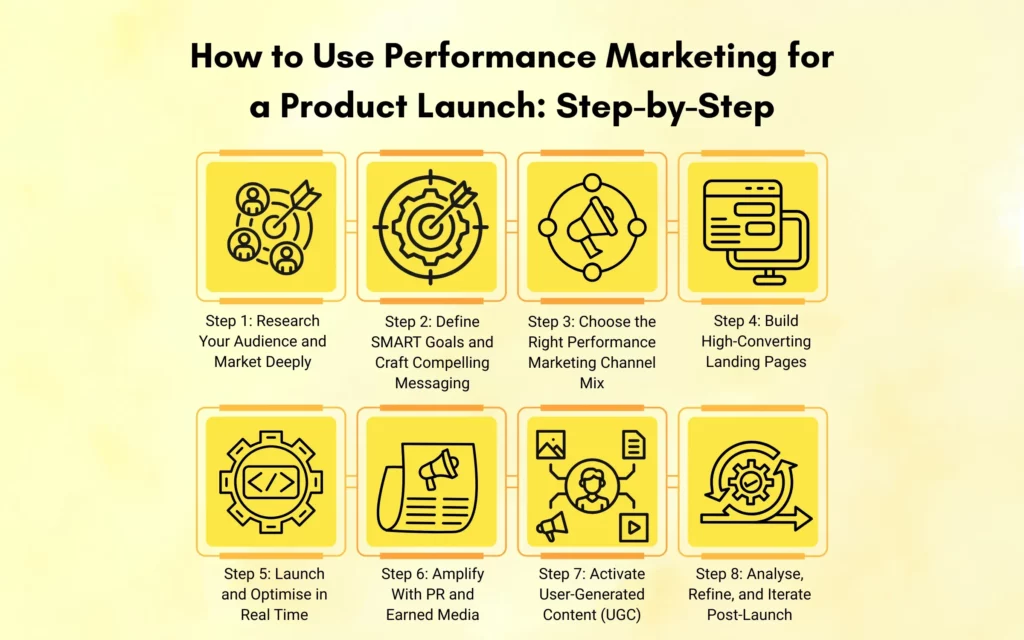
Product launches are high-stakes and time-sensitive. A well-executed performance marketing strategy gives you the targeting precision and real-time feedback needed to maximise impact from day one — and course-correct before budget is wasted.
Step 1: Research Your Audience and Market Deeply
Before spending a single rupee on any performance marketing channels, build a detailed understanding of who you’re targeting. Develop a comprehensive Ideal Customer Profile (ICP) using:
- Social media listening and community monitoring
- Customer surveys and one-to-one interviews
- Competitor gap analysis — what are they missing that you can own?
- Search trend data via Google Trends and keyword research tools
Demographic research matters but behavioural research matters more. Gen Z audiences, for instance, consistently reward authenticity and social responsibility in brand messaging — campaigns that ignore this underperform regardless of budget or channel.
Competitor analysis should identify not just what rivals offer but where their positioning is weak. A 2023 McKinsey report highlights customer experience (CX) differentiation as the fastest-growing source of competitive advantage — your product launch messaging should speak directly to the gaps competitors leave open.
Step 2: Define SMART Goals and Craft Compelling Messaging
Set goals that are Specific, Measurable, Achievable, Relevant, and Time-bound before touching any ad platform. According to Forrester, 74% of B2B marketers who set SMART campaign goals report better alignment between marketing spend and business outcomes.
Relevant launch goals for a digital performance marketing campaign include:
- Website traffic volume targets within a defined timeframe
- Pre-order or sign-up numbers before launch date
- App downloads in the first 30 days
- Lead volume and quality thresholds for B2B launches
With goals defined, craft messaging that leads with user benefits — not product features. A/B test multiple copy variations from campaign launch to identify which angle resonates before scaling spend behind it.
Step 3: Choose the Right Performance Marketing Channel Mix
Not every channel suits every product. The optimal performance marketing channels for your launch depend on where your specific audience spends time and what stage of awareness they’re at:
- SEM captures high-intent users actively searching for solutions your product solves — highest purchase intent of any channel
- Paid social builds awareness and drives consideration among precisely targeted demographic and interest-based audiences
- Affiliate and influencer marketing — global influencer marketing spend exceeded $16 billion and continues growing; micro-influencers with niche engaged audiences frequently deliver higher ROI per rupee than macro-influencers
- Email marketing nurtures warm leads and existing subscribers through the consideration phase toward conversion
- Retargeting campaigns re-engage users who showed intent — visited your site, watched your video, engaged with an ad — but didn’t convert on first contact
Our digital marketing team helps businesses identify the right channel mix based on product category, audience behaviour, and budget constraints.
Step 4: Build High-Converting Landing Pages
Your performance marketing metrics are only as strong as the page your ads send traffic to. Every campaign needs a dedicated landing page that:
- Has one clear, singular objective — sign up, purchase, or download
- Matches the ad’s messaging and visual language exactly (message match)
- Contains a prominent, action-oriented CTA above the fold
- Loads in under 3 seconds on mobile — every second of delay reduces conversions measurably
- A/B tests headlines, CTAs, imagery, and form length continuously
Content marketing running in parallel — blog posts, explainer videos, comparison guides — builds pre-launch organic interest, strengthens SEO authority, and warms audiences who aren’t yet ready to convert on paid ads alone. Our web development team builds landing pages engineered for both speed and conversion rate performance.
Step 5: Launch and Optimise in Real Time
Go live across your chosen performance marketing channels and monitor performance marketing metrics from hour one. Track simultaneously:
- Impressions, clicks, and CTR per individual ad creative
- Conversion rates per landing page variant
- CPA and ROAS across all active channels
- Performance by device, audience segment, and time of day
The defining advantage of digital performance marketing over traditional approaches is agility. If an ad creative isn’t hitting target CTR within the first 48–72 hours, revise it immediately. If one channel is delivering qualified leads at half the CPA of another, reallocate budget now — not at end of month.
Step 6: Amplify With PR and Earned Media
Paid performance marketing channels and public relations work together more effectively than either does alone. A compelling press release highlighting your product’s unique value proposition, pitched to relevant journalists and industry publications, generates earned coverage that paid ads cannot replicate at any budget.
Social listening tools help identify relevant conversations, trending topics, and influencers to engage with organically — creating brand mentions that reinforce paid campaign messaging without additional ad spend.
Step 7: Activate User-Generated Content (UGC)
UGC is one of the most cost-effective performance drivers available and directly improves performance marketing metrics across every paid channel that features it. Activate it through:
- Social media contests and creative challenges tied to your launch
- Post-purchase review and testimonial request sequences
- Partnerships with micro-influencers for authentic, audience-specific endorsements
Positive UGC acts as social proof — it reduces purchase hesitation and improves conversion rates on paid social and landing pages simultaneously. Canva built a significant portion of their growth strategy on exactly this principle.
Step 8: Analyse, Refine, and Iterate Post-Launch
The launch date is the beginning of your performance marketing strategy — not the conclusion. Post-launch analysis should systematically answer:
- Which channels delivered the lowest CPA at scale?
- Which audience segments converted at the highest rate?
- Which messages and creatives drove the most qualified leads or sales?
- Where in the funnel did the largest volume of users drop off?
Use these insights to refine ongoing campaigns, reduce CAC over time, inform future product launches, and build a compound performance advantage — each campaign making the next one more efficient.
Real-World Performance Marketing Examples
Case Study 1: Dollar Shave Club — Viral Creative Meets Paid Performance
Challenge: Enter a market dominated by Gillette and Schick with minimal brand recognition and a limited launch budget.
Performance marketing strategy: A single, high-quality viral YouTube video (“Our Blades Are F*cking Great”) combined with precisely targeted Google Ads and paid social campaigns, a conversion-optimised sign-up landing page, and rigorous CPA tracking across every channel.
Key performance marketing metrics tracked: Cost per new subscriber, conversion rate from ad click to sign-up, video view-through rate, and CPA versus CLV ratio.
Results: Millions of organic video views generated brand awareness at near-zero cost. Paid search and social campaigns converted that awareness into subscribers efficiently. The campaign generated enough market disruption to force responses from established multi-billion dollar competitors within months of launch.
Key lesson: Creative quality and performance marketing channel targeting are not opposing forces — when combined deliberately, they multiply each other’s impact.
Case Study 2: Canva — Micro-Influencer Performance Marketing at Scale
Challenge: Enter a crowded design software market dominated by Adobe with no brand recognition and limited budget for traditional advertising.
Performance marketing strategy: Rather than broad awareness spend, Canva built a micro-influencer programme targeting niche design communities. They ran design challenges, tracked every influencer partnership with unique UTM links and discount codes to measure CPA per partner, combined a freemium model with paid social acquisition, and built organic social presence through curated user-generated content.
Key performance marketing metrics tracked: CPA per influencer partner, free-to-paid conversion rate, CAC versus CLV, and social engagement rate per campaign.
Results: Tracked influencer partnerships enabled continuous optimisation — underperforming partners were replaced, high-performing ones scaled. The freemium model converted a large free user base into paying subscribers over time. Canva scaled to become the dominant design platform for non-professional users globally — competing directly with Adobe at a fraction of traditional marketing spend.
Key lesson: Micro-influencers with highly engaged niche audiences consistently outperform broad celebrity partnerships on a cost-per-acquisition basis. Tracking every partnership as a performance marketing channel — with measurable CPA — is what separates strategic influencer marketing from brand spending.
Emerging Trends in Performance Marketing (2026)
The digital performance marketing trends landscape continues to evolve rapidly. Key developments to build into your strategy now:
Cookieless tracking — with third-party cookies phased out across major browsers, contextual targeting and first-party data collection are now foundational requirements, not optional upgrades. Brands without first-party data strategies face significant performance marketing metrics degradation.
AI-powered campaign optimisation — machine learning tools now handle audience segmentation, real-time bid management, ad creative testing, and personalisation at a scale impossible manually. Every major ad platform’s algorithm rewards advertisers who feed it quality first-party data.
Omnichannel attribution — consumers interact across 6–8 touchpoints before converting. Last-click attribution models dramatically undervalue upper-funnel performance marketing channels like paid social and display. Unified attribution models that credit the full customer journey are replacing single-touch models across sophisticated marketing organisations.
Short-form video as a performance channel — TikTok, Instagram Reels, and YouTube Shorts now offer direct conversion tracking, making them genuine performance marketing channels rather than purely brand awareness tools. Performance-optimised short-form video creative is one of the highest-ROI investments available in 2026.
How Betatest Solutions Delivers Performance Marketing Results
At Betatest Solutions, our approach to performance marketing strategy is built on the same principles outlined in this guide — audience-first research, channel selection based on data rather than assumption, conversion-optimised creative and landing pages, and rigorous ongoing optimisation.
As a full-service performance marketing agency, we combine digital performance marketing execution with strategic consulting to ensure campaigns align with your broader business objectives — not just platform metrics. Our quality assurance team validates every campaign setup before spend goes live, preventing the costly tracking errors that distort performance marketing metrics and lead to bad budget decisions.
Whether you’re launching a new product, scaling an existing acquisition programme, or trying to reduce CAC while growing volume, we build and manage performance marketing strategies that prove their value clearly.
Frequently Asked Questions (FAQs)
Performance marketing is a digital advertising model where you pay only when a specific action occurs — a click, lead, sale, or sign-up. Unlike traditional advertising where you pay for exposure regardless of results, every rupee in a performance marketing strategy is tied to a measurable, trackable outcome.
Digital marketing is the broader category — it includes SEO, content marketing, social media, email, and paid advertising. Performance marketing is a subset focused specifically on paid, outcome-based campaigns where spend is directly tied to conversions. All performance marketing is digital marketing, but not all digital marketing is performance marketing.
The most critical performance marketing metrics are CPA (Cost Per Acquisition), ROAS (Return on Ad Spend), CAC (Customer Acquisition Cost), CLV (Customer Lifetime Value), and Conversion Rate. The relationship between CAC and CLV is particularly important — a low CPA means nothing if the customers acquired don’t generate enough long-term revenue to justify the spend.
Yes — it’s arguably better suited to small businesses than traditional marketing because budgets are fully flexible. You can start with a small daily budget across one or two performance marketing channels, measure what works, and scale only the campaigns that prove ROI. There are no large upfront commitments as with TV or print.
Initial data appears within 24–72 hours of launch. Meaningful optimisation — where you have sufficient data to make confident decisions — typically takes 2–4 weeks. Full campaign maturity, where ad platform algorithms have learned your best-converting audiences, usually takes 4–8 weeks depending on budget and volume.
Sending paid traffic to a poor or generic landing page. You can have a perfect performance marketing strategy with ideal channel selection and targeting, but if the landing page is slow, unclear, or mismatched to the ad’s promise, conversion rates will be low and CPA will be inflated. The landing page is where performance marketing ROI is won or lost.
Absolutely. LinkedIn Ads, account-based marketing (ABM), content syndication with lead tracking, and SEM targeting business-specific keywords are all proven B2B performance marketing channels. The key difference from B2C is longer sales cycles — lead quality and pipeline contribution metrics matter more than raw volume.
The most effective 2026 approach is hybrid. Traditional marketing builds brand awareness and trust at scale. Digital performance marketing then converts that awareness into measurable actions at lower CPA — because audiences already familiar with your brand convert more efficiently on paid channels. Traditional investment directly improves performance marketing efficiency when both are tracked together.
Look for transparent reporting on actual performance marketing metrics — not vanity metrics like impressions. A credible performance marketing agency should be able to show you CPA, ROAS, and CAC from previous campaigns, explain their attribution methodology clearly, and align campaign KPIs to your business revenue goals rather than platform-specific benchmarks.