
Agentic AI vs RPA: Key Differences and How to Choose the Right Automation for Your Business (2026)
Automation is no longer a question of whether — it is a question of which kind.
Two technologies dominate the conversation today: Robotic Process Automation (RPA) and Agentic AI. Both promise to reduce manual work and cut costs. But they are fundamentally different in how they operate, what problems they solve, and where they fall short.
If your team is evaluating automation investments in 2026, understanding agentic AI vs RPA is not a technical exercise — it is a business-critical decision. Whether you are a business owner trying to reduce operational costs or a CTO mapping an enterprise automation strategy, this guide explains both clearly, compares them side by side, and helps you decide which fits your specific situation.
What Is RPA (Robotic Process Automation)?
Robotic Process Automation, or RPA, uses software bots to mimic human actions on a computer. Think of it as a very fast, tireless employee who follows a fixed script — clicking buttons, copying data, filling forms, and moving information between systems.
RPA bots work on top of existing applications without changing the underlying systems. They follow rules. They do not think, infer, or handle exceptions. If the user interface changes or an unexpected input arrives, most RPA bots will fail or raise an error. Tools like UiPath, Automation Anywhere, and Blue Prism are among the most widely used RPA platforms in enterprise environments today.
Common RPA use cases:
- Extracting data from invoices and entering it into an ERP system
- Automating employee onboarding form submissions
- Processing insurance claims from a standard template
- Generating and emailing weekly reports from fixed data sources
- Moving records between legacy and modern software
What Is Agentic AI?
Agentic AI refers to AI systems that can plan, reason, make decisions, and take actions across multiple steps — without needing a human to direct every move. Unlike a chatbot that answers questions, an AI agent pursues goals.
An agentic AI system is built on a large language model (LLM) combined with tools (web search, APIs, databases), memory (short-term and long-term), and a planning layer. It can read an email, understand the context, decide what to do, call the right system, draft a response, and send it — all autonomously. To understand how AI agents are structured, see our detailed guide on what is agentic AI.
Common agentic AI use cases:
- Handling complex customer support queries end-to-end
- Researching suppliers, comparing options, and drafting a procurement brief
- Monitoring a codebase, identifying bugs, and submitting a fix
- Analysing financial reports and generating a strategy memo
- Managing multi-step sales outreach personalised per contact
Agentic AI vs RPA: Side-by-Side Comparison
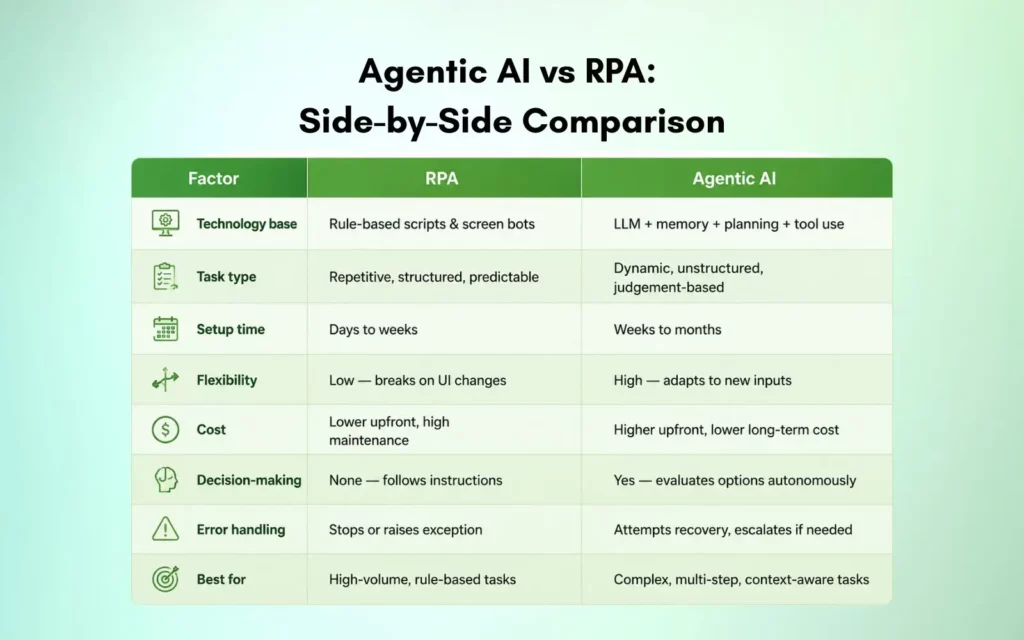
| Factor | RPA | Agentic AI |
| Technology base | Rule-based scripts & screen bots | LLM + memory + planning + tool use |
| Task type | Repetitive, structured, predictable | Dynamic, unstructured, judgement-based |
| Setup time | Days to weeks | Weeks to months |
| Flexibility | Low — breaks on UI changes | High — adapts to new inputs |
| Cost | Lower upfront, high maintenance | Higher upfront, lower long-term cost |
| Decision-making | None — follows instructions | Yes — evaluates options autonomously |
| Error handling | Stops or raises exception | Attempts recovery, escalates if needed |
| Best for | High-volume, rule-based tasks | Complex, multi-step, context-aware tasks |
Real-World Scenario: Invoice Processing
Invoice processing is a task both technologies can handle — but in very different ways.
RPA Approach An RPA bot opens the email inbox, detects a PDF attachment, extracts predefined fields (vendor name, amount, date), and pastes them into your accounting system.
Fast, consistent, zero errors on standard invoices. Fails when the PDF format changes, a field is missing, or there is a dispute note in the email body.
Result: Requires a human to handle all exceptions — which can be 20–40% of real-world invoices.
Agentic AI Approach An AI agent reads the email including any notes or disputes, extracts invoice data even from non-standard formats, checks vendor history in your ERP, flags discrepancies, drafts a reply if clarification is needed, and routes it for approval — only escalating to a human when genuinely uncertain.
Handles exceptions, unstructured data, and multi-step decisions. Higher setup cost and requires careful guardrails for financial accuracy.
Result: Handles 80–90% of invoices end-to-end, including exceptions.
When RPA Is the Right Choice
RPA is still the right tool in many scenarios. It remains one of the most cost-effective solutions for workflow automation in enterprise settings where tasks are predictable and volume is high. RPA wins when:
- Your process is highly structured and never changes
- You need to process thousands of identical records daily at low cost
- The task requires a strict, auditable, step-by-step trail for compliance
- Your team has limited AI readiness and needs a quick deployment
- You are working with legacy systems where API access is not available
The key is recognising that RPA is a speed tool, not an intelligence tool.
When Agentic AI Is the Right Choice
Agentic AI earns its place when your workflows involve judgement, variation, or multi-system coordination. Understanding when to use RPA vs AI agents comes down to one core question: does your task require thinking, or just doing? Agentic AI is the right choice when:
- Processes involve unstructured inputs — emails, documents, voice, images
- You want to reduce human escalations and handle exceptions automatically
- Tasks require cross-system actions (CRM + email + calendar + database)
- The business goal changes frequently and your automation needs to adapt
- You are building customer-facing automation where quality of reasoning matters
For enterprise leaders planning AI adoption at scale, our Agentic AI strategy guide for CTOs covers risks, governance frameworks, and the rollout roadmap in detail.
Quick Decision Guide: RPA or Agentic AI?
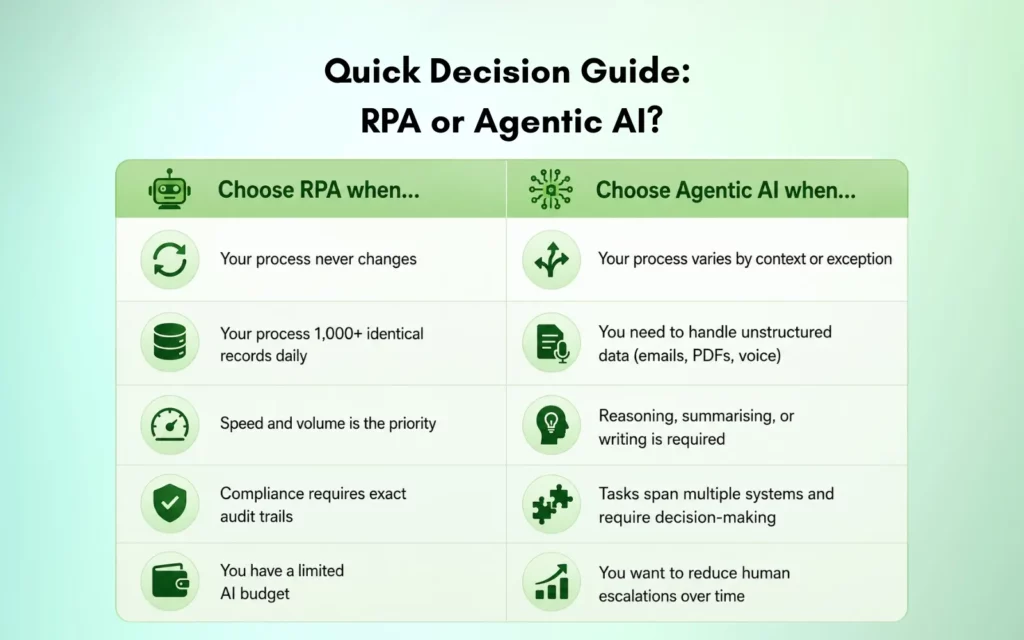
| Choose RPA when… | Choose Agentic AI when… |
| Your process never changes | Your process varies by context or exception |
| You process 1,000+ identical records daily | You need to handle unstructured data (emails, PDFs, voice) |
| Speed and volume is the priority | Reasoning, summarising, or writing is required |
| Compliance requires exact audit trails | Tasks span multiple systems and require decision-making |
| You have a limited AI budget | You want to reduce human escalations over time |
The Hybrid Approach: Using Both Together
The most powerful automation architectures in 2026 do not choose one or the other — they use both in their appropriate roles. This combined model is what industry analysts refer to as Intelligent Process Automation (IPA) — where the reasoning capability of agentic AI is layered on top of the execution speed of RPA.
A common pattern: an agentic AI layer handles the front-end reasoning — reading inputs, making decisions, routing tasks — while RPA bots execute specific high-volume structured sub-tasks in the background. The AI agent acts as the brain; the RPA bot acts as the hands.
Example: A customer onboarding workflow where the AI agent reads the application form, verifies information, communicates with the applicant via email, and triggers an RPA bot to create accounts in four internal systems simultaneously.
This kind of cognitive automation or hyperautomation is where most enterprise automation roadmaps are heading. To see specific industry examples, read our post on agentic AI use cases and real-world examples.
How to Choose: 4 Questions to Ask Before You Decide
1. Is the process rule-based and predictable, or does it require judgement? → Rule-based = RPA. Requires judgement = Agentic AI.
2. What percentage of cases are exceptions or edge cases? → Under 10% exceptions = RPA works well. Over 20% = Agentic AI adds more value.
3. Does the task involve reading unstructured content (emails, documents, free text)? → Yes = Agentic AI. No (only structured data) = RPA.
4. What is your tolerance for setup cost vs long-term maintenance cost? → Lower upfront budget = start with RPA. Prioritising long-term scalability = invest in Agentic AI.
Key Takeaway: Agentic AI vs RPA at a Glance RPA automates repetitive, rule-based tasks by following a fixed script. It is fast, affordable, and ideal for high-volume structured work — but breaks on exceptions. Agentic AI uses large language models to reason, decide, and act across complex, multi-step tasks. It handles unstructured data, adapts to change, and reduces human escalation — but requires a higher initial investment. Most enterprise automation strategies in 2026 combine both: Agentic AI for reasoning and orchestration, RPA for high-volume execution.
Conclusion
Agentic AI vs RPA is not a competition — it is a spectrum. RPA solves the problem of volume and repetition. Agentic AI solves the problem of complexity and judgement. The businesses gaining the most from automation in 2026 are those that have stopped asking “which one?” and started asking “where does each one belong?”
If your processes are structured, predictable, and high-volume — start with RPA. If your workflows involve exceptions, unstructured data, or multi-step decisions — agentic AI is the right investment. And if you want to build a truly scalable automation layer for your business, the answer is almost certainly both, working together.
The good news: you do not have to figure this out alone. Understanding your current processes, mapping automation opportunities, and building the right technology stack is exactly what an experienced IT partner does.
For a broader look at how AI is reshaping the way software and services are built and delivered, explore our post on how AI is transforming the IT service sector.
Not sure which automation fits your business? Our agentic AI and automation consultants at Betatest Solutions help you evaluate your current processes, identify the right approach, and build a roadmap that delivers ROI. 👉👉 Book a free consultation: betatestsolutions.com/contact-us
FAQs
RPA follows pre-defined rules and scripts to automate repetitive, structured tasks. Agentic AI uses large language models to reason, plan, and make decisions across complex, multi-step workflows. RPA executes instructions; agentic AI pursues goals.
No. RPA remains highly effective for high-volume, structured, rule-based automation — especially in finance, HR, and operations. Agentic AI complements RPA rather than replacing it. Most advanced automation architectures in 2026 use both technologies together.
Not in most enterprise environments. Agentic AI is not designed for the high-speed, high-volume structured processing where RPA excels. It is better suited to tasks requiring judgement, unstructured input handling, and multi-system coordination.
RPA has a lower upfront cost and faster deployment. Agentic AI has a higher initial investment but lower long-term maintenance cost, especially as processes evolve. The right choice depends on task complexity and your volume of exceptions.
Intelligent Process Automation combines RPA with AI capabilities — including agentic AI, machine learning, and natural language processing — to automate end-to-end business processes that include both structured and unstructured elements.
Start by identifying high-exception, multi-step processes where human decision-making is currently required. Engage an agentic AI development partner to map your automation roadmap, define guardrails, and run a proof of concept on a single workflow before scaling.